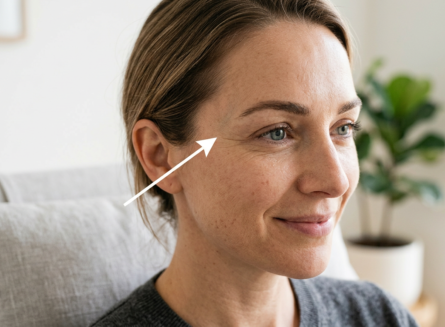

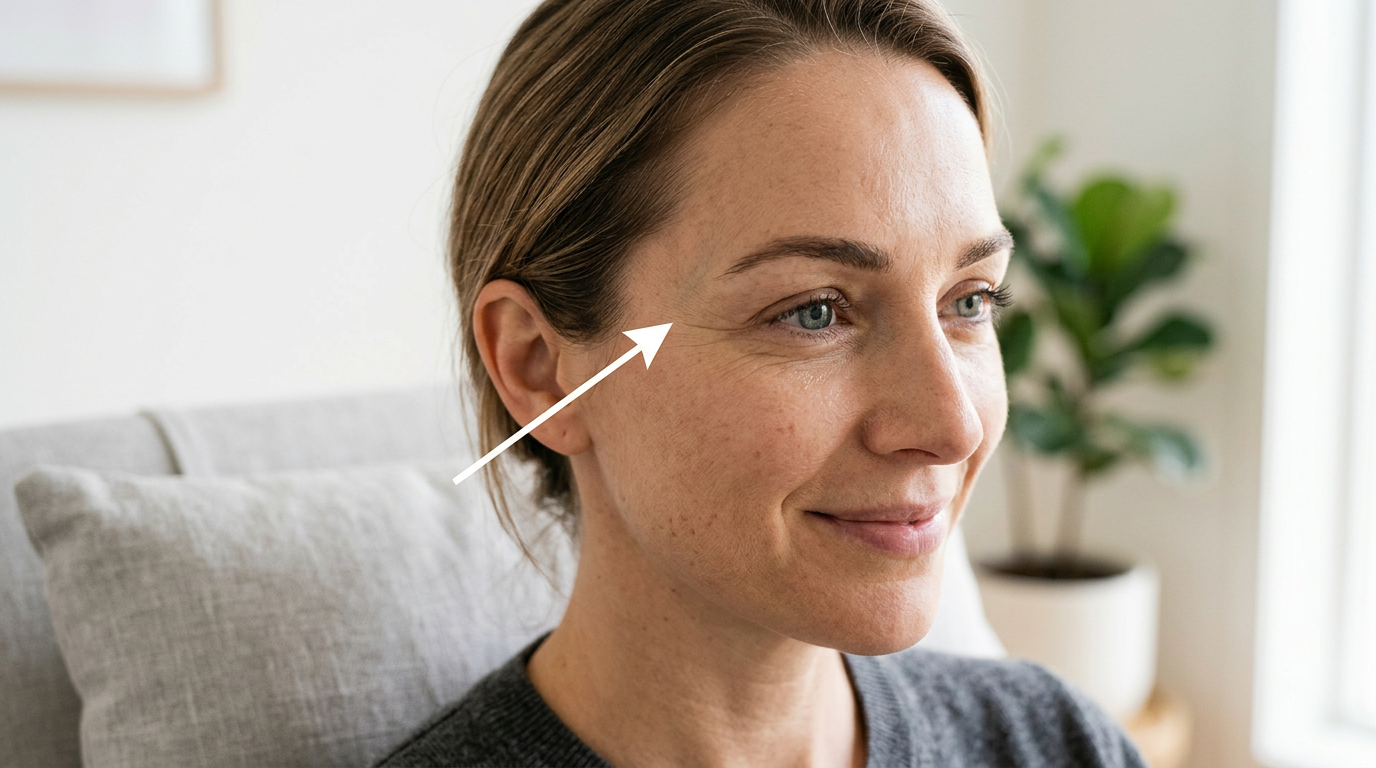
Temple filler subtly restores volume lost through natural bone resorption, fat depletion, and muscle thinning, creating a smooth contour between the brow and hairline. This rebalances a pinched upper facial shape, softens prominent orbital rims, and provides a gentle lateral lift to the outer brow. While structural support is immediate, final results settle over a couple of weeks following a thirty to forty-five minute appointment. Learn more about Temple filler here.
When people think about facial rejuvenation, they often focus on the lips, cheeks, or jawline. Yet the upper face plays a subtle, crucial role in how rested and balanced you appear. As natural ageing progresses, bone resorption and fat loss in the upper face create hollows that alter the overall shape of the face.
Evaluating temple filler results helps you understand how restoring this subtle area can soften harsh angles and rebalance your entire profile. In this guide, we explore why temporal hollowing occurs, how dermal filler works in this delicate area, and what real, unedited results look like in practice.
Understanding temple volume loss
The temporal region sits between the outer edge of your brow, the hairline, and the cheekbone. In our twenties, a soft layer of subcutaneous and deep fat pads keeps this area gently convex or flat.
Over time, several structural changes occur:
- Bone resorption: The temporal bone gradually thins and recedes, reducing structural support.
- Fat pad depletion: Both the superficial and deep temporal fat compartments shrink and descend.
- Muscle atrophy: The temporalis muscle naturally thins, exaggerating the indentation.
When these changes happen, the outer edge of the eye socket and the zygomatic arch become more pronounced. This creates what practitioners call a 'peanut-shaped' face, where the head looks pinched at the temples and wider at the cheekbones and jawline. For a comprehensive overview of how this treatment works and our approach at Kiss Aesthetics, explore our detailed guide to temple dermal filler treatment.
What actually changes?
Looking at temple filler results can be surprising because the treatment does not drastically alter your features. Instead, it subtly reframes them. The goal is never to create bulging temples, but rather to restore a smooth, continuous line from the forehead down into the midface.
Here is how the upper face typically transforms once the treated area settles:
HOLLOW TEMPLE CONTOUR RESTORED TEMPLE CONTOUR
--------------------------------------- ---------------------------------------
Visible hollows beside the eyes Smooth, flat to slightly convex contour
Prominent, sharp bony orbital rim Soft transition from brow to hairline
Tired or drawn appearance around brows Subtle lateral lift to the brow tail
Exaggerated 'pinched' upper face shape Balanced, oval or heart-shaped profile
When assessing hollow temple filler results, the most noticeable difference is often perceived around the eyes. By providing fresh structural support beneath the skin, the tail of the eyebrow receives a gentle lift, helping you look refreshed and less fatigued without looking overfilled.
The impact on overall facial balancing
The temples do not exist in isolation. Treating the midface without addressing significant temporal hollowing can sometimes make the cheeks appear overly prominent or disjointed.
In modern aesthetic medicine, we treat the face as an interconnected canvas. Restoring the temples supports overall harmony, particularly when combined with cheek filler treatments to create a smooth sweep across the upper and middle thirds of the face. Practitioners refer to this comprehensive methodology as full facial balancing, ensuring every feature complements your natural bone structure.
What happens during the procedure?
Temple augmentation requires advanced anatomical knowledge and precision. The temporal fossa houses major blood vessels, including the superficial temporal artery and deep temporal arteries, which means practitioner experience is paramount.
Here is what you can expect during a typical appointment:
- Detailed consultation Your practitioner assesses your facial structure, reviews your medical history, and discusses your aesthetic goals.
- Skin preparation The area is thoroughly cleansed with medical-grade antiseptic, and a topical numbing agent may be applied for comfort.
- Careful product placement Using either a fine needle placed deep on the bone or a blunt micro-cannula in the superficial layers, premium hyaluronic acid filler is slowly introduced.
- Gentle moulding The practitioner softly massages the product into place to ensure a perfectly smooth contour.
- Aftercare review You receive tailored aftercare instructions and a follow-up plan to monitor your healing.
Most appointments take around thirty to forty-five minutes, with the injection process itself lasting only ten to fifteen minutes.
Understanding healing and downtime
While dermal filler provides an immediate structural boost, your final appearance settles over a couple of weeks as swelling resolves and the product integrates with surrounding tissue. For a detailed day-by-day breakdown of post-treatment stages, read our temple filler healing stages guide.
Safety and choosing the right practitioner
Because the temple area contains complex vascular networks, choosing an experienced, medically trained injector is essential. In the UK, safe practice standards recommend that all dermal filler procedures take place in clean, clinical environments following comprehensive patient assessments.
During your consultation at our Ascot clinic, we carefully evaluate your anatomy and discuss whether temple dermal filler suits your specific needs. We believe in open, honest advice, meaning if a treatment is not appropriate for your facial structure, we will always tell you.
Essential aftercare steps
To protect your results, avoid pressing the area, sleeping on your side, or doing strenuous workouts for forty-eight hours. You should also avoid tight headwear or heavy glasses that press directly onto the injection sites while the product settles. For full instructions on managing early swelling and protecting your results, refer to our complete healing guide.
Restoring volume to the temples is one of the most effective ways to soften facial contours and regain a fresh, rested look without looking overdone.
Who benefits most from temple filler?
Temple volume loss happens gradually over time, but certain people notice the change earlier or more distinctly than others.
You might find this treatment particularly helpful if you:
- Have an athletic build or naturally lower body fat, which can make the upper face look hollow sooner.
- Notice that the outer tail of your eyebrow has dropped or feels unsupported.
- Feel your face has taken on a narrower, pinched appearance at the temples that exaggerates the width of your cheekbones.
- Want to soften prominent bony edges around the eye sockets without changing your natural expressions.
For beginners, starting with a conservative volume replacement in the temples helps create a smoother transition from the forehead to the midface, keeping your overall appearance balanced and refreshed.
Questions to ask during your consultation
Walking into a clinic for the first time can feel overwhelming, especially when discussing a subtle area like the temples. Being prepared with practical questions helps you understand the treatment steps and feel confident in your care.
Here are a few helpful questions to bring to your consultation:
- Which injection technique do you recommend for my specific facial anatomy, and why?
- How much product do we need to start with to keep the change natural and gradual?
- Will restoring my temples change how my cheekbones or under-eye area appear?
- What should I expect during the first two to four weeks while the filler settles into place?
- How can I best protect the area during the initial 48 hours of recovery?
We encourage you to take your time, discuss every detail with your practitioner, and make sure all your questions are answered before deciding to proceed.
Pairing structural filler with skin rejuvenation
While dermal filler restores structural volume beneath the skin, the quality and hydration of your skin surface also contribute to a fresh, healthy appearance. Many people choose to support their filler results with complementary skin treatments once healing is complete.
For instance, after your temple filler has fully integrated over two to four weeks, treatments like Profhilo can deliver deep hydration and improve skin firmness across the face and neck. If you want to address surface texture, fine lines, or dullness, professional chemical peels or microneedling sessions can stimulate healthy cell renewal. Combining structural support with targeted skin health provides a harmonious, balanced result that looks fresh from every angle.
Frequently asked questions
How long do temple filler results last?
Temple fillers typically last between twelve and eighteen months. Because the temporal area experiences relatively little movement compared to the lips or mouth, the hyaluronic acid product breaks down slowly and steadily.
How many millilitres of filler are needed for temples?
Most individuals require between 0.5 ml and 1.0 ml per side, depending on the severity of volume loss. Your practitioner will recommend a tailored amount during your consultation to achieve natural balance.
This article is for general information only and is not medical advice. Suitability for any treatment is confirmed at a consultation with a qualified practitioner.